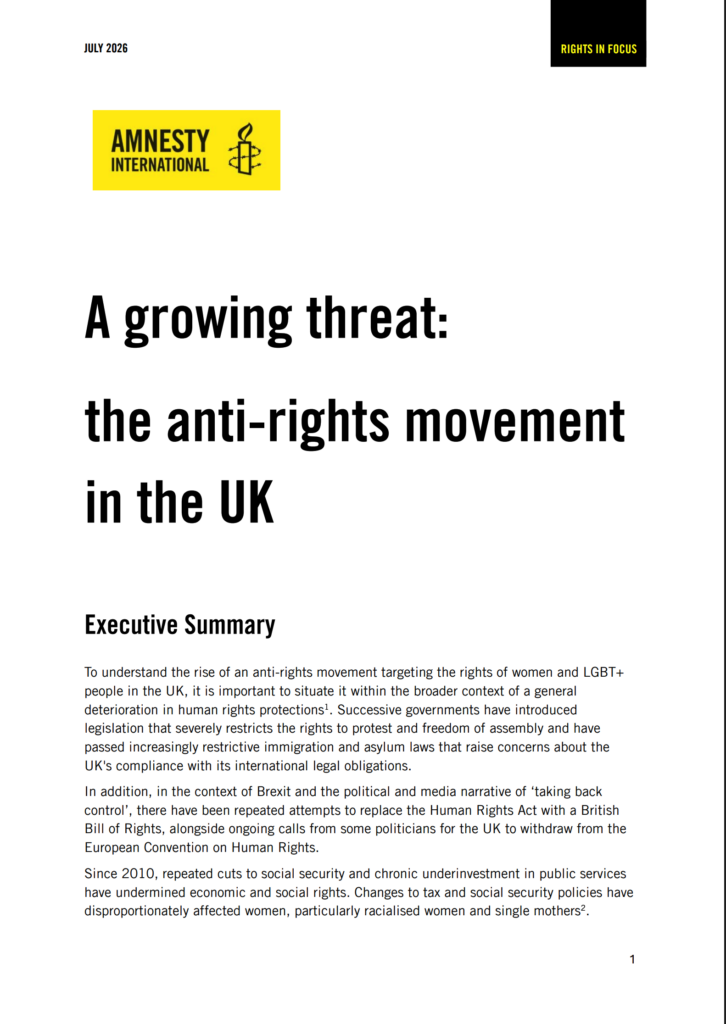
Amnesty International recently published a report on what they call the “anti-rights movement” in the UK, which also includes gender critical activism. It did not take long before the gender critical TERFs – which normally think of themselves as defenders of free speech – forced Amnesty to take the report down. Amnesty is now reviewing the report.
By Jack Molay
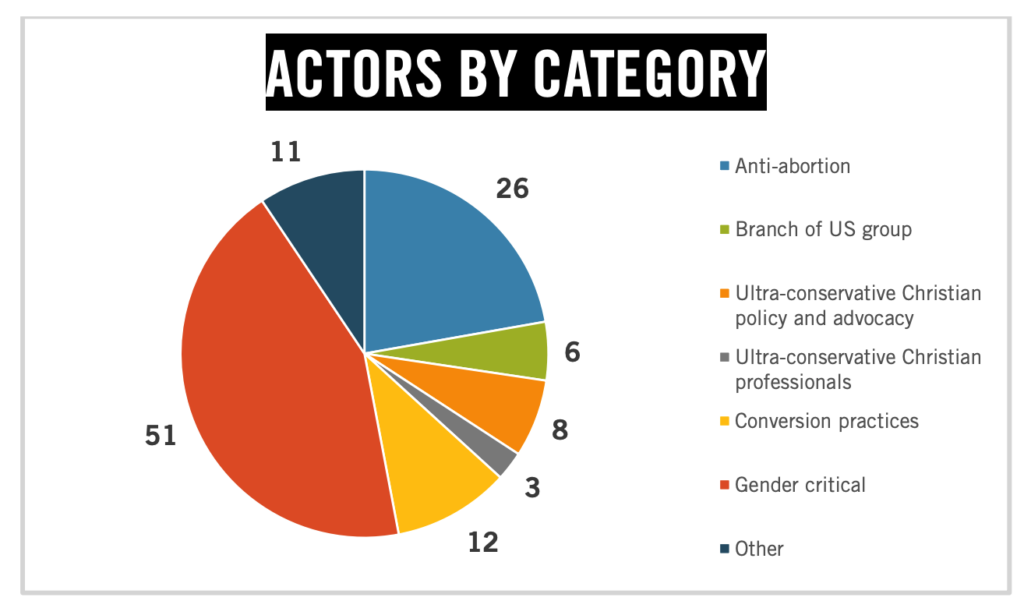
A Growing Threat: the Anti-Rights Movement in the UK mapped 117 organisations, including anti-abortion groups, organizations promoting conversion practices, branches of US Christian-right organizations and 51 groups described as “gender critical.”
This is not the first time Amnesty has argued that the campaign against transgender rights is an increasingly organized political movement using litigation, lobbying, media influence and institutional networks to restrict legal gender recognition, healthcare and trans people’s participation in public life.
Amnesty has also pointed out that anti-trans activism has affected media coverage of trans lives. Amnesty’s more detailed May briefing found that four British newspapers published almost 17,000 articles concerning trans people in just over five years, around nine every day, while trans voices were almost absent.
The new report made some observations that everyone who has been following the current anti-trans hysteria will recognize:
TERFs are part of a larger anti-human rights system
The gender critical movement is part of a larger system of anti-rights organizations, that target women, immigrants, LGBTQ-people, people of color and more. Amnesty put it this way:
“These organisations form part of a wider anti-rights ecosystem—a network of groups that work on different issues but share similar goals and often support each other’s efforts to roll back human rights protections.”
J.K. Rowling and the “trans-exclusionary radical feminists” (TERFs) are unsurprisingly uncomfortable with being grouped with fascists and religious extremist, even though they as far as trans people go share the same opinions and use the same talking points.
(Amnesty does not use the tern TERF, and refer instead to “gender critical” organizations.)
The effects on other groups
Another point that is bound to make any TERF angry is Amnesty pointing out that they by targeting fundamental human rights principles, also undermines the protection of cis people.
Yes, the following paragraph is primarily addressing religious fanatics and the extreme right, but the main argument holds true: When you violate fundamental human rights principles when addressing one marginalized group, that will make it more likely that others will use the same tactics against other groups.
“Some of these groups describe themselves as ‘anti-gender’ because they visibly oppose the rights and equality of women and LGBT+ people. However, by targeting women and LGBT+ people, they also challenge a fundamental human rights principle: that human rights belong to everyone equally. Human rights are interconnected and mutually reinforcing. When the rights of one group are restricted, protections for others can also be weakened, even where the effects are not immediately visible.”
The origins of “gender ideology”
In the report Amnesty also argues that nearly anti-rights groups, TERFs included, use the term “gender ideology” to present some undefined and false idea of a conspiracy of fanatics trying to upend the natural order of society and nature.
“Anti-rights actors seek a society in which women and men have fixed and distinct roles, based on what they view as ‘natural’ and ‘traditional’. These actors perceive the idea that gender is socially constructed as a threat because it suggests that gender roles can, and do, change across societies and over time.
“In fact, progress in the rights of women and LGBT+ people has been underpinned by changing understandings of gender and social roles. Anti-rights actors refer to this perceived threat as ‘gender ideology’, portraying it as an attack on national traditions, family structures, marriage and religious freedom. These narratives often seek to generate fear and uncertainty and rely on misinformation or exaggerated claims.”
Let me add here that all the reactionary groups Amnesty cover make use of the concept of “biological sex” to stop any discussion of what is clearly true: That for some people the gender assigned at birth does not match their deep experienced identity. The anti-trans activists are suppressing this scientifically documented truth by insisting that gender and “biological sex” are the same.
The irony is that the groups that talk about a monolithic gender ideology conspiracy, are themselves part of a such a conspiracy. That is a conspiracy where a large group of organizations and activists present the same simplistic and misleading narratives about both sex and gender in order to defend their irrational hatred of trans people.
The Gender Critical category is the largest
Of all the hate groups identified (my term, not Amnesty’s) the gender critical group is the largest.
Note that this figure in itself is extremely dangerous for the TERFs. It gives people a clear picture of the fact that gender critical activism is part of a larger system of oppression, hate and persecution.
J.K. Rowling’s reaction to all of this is predictable. She presents herself and her transphobic allies as victim of Amnesty’s oppression. Amnesty, according to her, believes that some people do not deserve rights, as women, girls and those who are same-sex attracted.
This is classical psychological projection: Accuse your opponent for being like yourself. This is, of course, completely unbelievable. Amnesty has an impeccable reputation as regards the rights of women and LGBTQ people. And this very report was written in defense of women and queer people.
Note that the report was written and published by the UK branch of Amnesty International. The international organization was apparently not involved in the production of the report.
The organizations listed
The report also included a list of the anti-rights organizations mapped by Amnesty. The TERFs need to stop this list from becoming public knowledge, because having a renowned human rights organization add you to a list with conversion therapy supporters, anti-abortionists, fascists and religious fanatics undermines the idea that you are a democratic defender of defenseless women and children.
Amnesty UK did probably make a mistake here, as they did not explain why the various organizations meet the “anti-rights” definition. An appendix with that information would have saved them from a lot of legal problems.
The inclusion of Beira’s Place, Rowling’s cis women-only support service for sexual-violence survivors, makes sense, but it allowed opponents to claim that Amnesty has “blacklisted” a rape-crisis service. They can now use this to redirect the discussion from the oppression of trans people to the oppression of a white, upper class, reactionary hater with a fortune of 1.2 billion US dollars.
I am afraid that fighting evil is a complex play of chess where you have to think at least five moves ahead and understand that your opponent may change the rules at any time.
Here are the gender critical organizations and networks listed in the report.
Seen Network (Sex Equality and Equity Network Limited) Seen in the City SEEN in HR Parli SEEN SEEN in STEM SEEN in Journalism SEEN in Schools SEEN in Sport SEEN in Health SEEN in Retail Local Authority SEEN TU SEEN SEEN in Publishing Third Sector SEEN Police SEEN UK SEEN on Campus FiLiA Bayswater support group Children of Transitioners Get the L Out UK Gender Critical Greens Labour Women’s Declaration Legal Feminist Lesbian Strength Merched Cymru OBJECT – Women Not Sex Objects! Older Feminist Network Protect & Teach Safe Schools Alliance UK (SSAUK) Trans Widows Voices Virago Women’s Workshop LGB Alliance Cymru Beira’s Place Conservatives for Women Fair Play for Women For Women Scotland Gay Men’s Network UK Keep Prisons Single Sex Let Women Speak (formerly Standing for Women) LGB Alliance The Lesbian Project Transgender Trend Woman’s Place UK (WPUK) Women’s Declaration International (WDI) Sex Matters Murray Blackburn and Mackenzie Women’s Rights Network (WRN) LGB Christians Liberal Voice for Women ScotPAG Scottish Professionals Advising on Gender
The Trump administration’s Department of Health and Human Services, led by Secretary Robert F. Kennedy Jr., has released an updated 400-page report on pediatric gender dysphoria that claims gender-affirming care for trans youth is harmful and insufficiently evidenced.
It is being promoted by HHS as a landmark, “peer-reviewed” document. But within hours of publication, major medical organizations, researchers, and LGBTQ advocates were describing it in very different terms: pseudoscience and politics dressed up as science.
The Trump administration’s Department of Health and Human Services (HHS) has released a report on transgender healthcare, which has been widely criticized for its lack of scientific rigor and reliance on pseudoscience.
The report, commissioned under Trump’s executive order, promotes conversion therapy for transgender youth and redefines social transition as medical treatment. It also suggests that transgender healthcare should be judged based on employment status and romantic relationships rather than patient well-being.
Medical experts, including the American Academy of Pediatrics, have condemned the report as misleading and inaccurate. It ignores established research showing the benefits of gender-affirming care and instead pushes an ideological agenda. The report also falsely claims that European countries are pulling back on transgender healthcare, despite recent medical guidelines in France, Germany, Austria, and Switzerland supporting gender-affirming care.
Here we have collected some articles analyzing the report and its consequences.
Dr. Susan J. Kressly, president of the American Academy of Pediatrics, said in a statement that “this report misrepresents the current medical consensus and fails to reflect the realities of pediatric care.”
“Though the report argues that this “exploratory therapy” is not the same as the long practice of “conversion therapy”—which is a practice of attempting to change someone’s sexual orientation or gender identity—advocates see little difference.”
“Gender dysphoria is a term that mental health professionals use to describe clinically significant distress someone feels because their sense of their gender does not match the sex they were assigned at birth. It is an official diagnosis in the DSM, a book published by the American Psychiatric Association that classifies mental disorders, but not everyone who identifies as transgender or gender-diverse has this diagnosis.
Gender-affirming care is a wide range of treatments offered by a multidisciplinary team that is tailored to the individual.
Ray Blanchard’s “autogynephilia” theory states that lesbian trans women are men who are sexually attracted to their own inner female. The hypothesis is used actively by transphobes to invalidate trans women as “paraphiliacs” or sexual perverts. The fact is, however, that the theory has been thoroughly debunked by both trans people and science.
On this page, we give you a selection of articles and papers that give you the history of Blanchard’s model of “transsexuality”, documentation on why it is misleading, information on how it hurts trans women and how it is used by transphobes today.
We also presents links to articles that covers J. Michael Bailey’s book on the topic: The Man who would be Queen.
We hope this resource page may be of help to trans and nonbinary people who reach for this theory when trying to explain their own sexuality and gender variance. The theory is based on 19th century concepts of sexuality and gender, so it feeds easily into internalized transphobia and homophobia among those who have been raised in a traditionalist culture.
Some highlights (documentation below):
Trans people, like cis people, are sexual beings with sexual fantasies, and for some trans people, especially those who have not transitioned, dreams about becoming their target sex may be eroticized. Such transformations open up for scenarios where they can have a sex life in harmony with their true selves.
Such fantasies are not limited to lesbian trans women. Many straight trans women and trans men have them too. Such fantasies have also been found among people who consider themselves cis.
The idea that there are two completely separate categories of trans women have been debunked by science.
Feeling sexy is not a sexual perversion, neither among cis people nor among trans people.
Lesbian trans women are perfectly capable of being attracted to other women.
Ray Blanchard, the man who came up with the autogynephilia hypothesis has never published any proof of his theory. Indeed, his own data debunks that there are two completely distinct categories of trans women. He is now actively helping “gender critical” transphobic “feminists” and white supremacists in their attacks on trans women.
Imane Khelif is a cis (non-transgender) woman who is very good at boxing . In spite of all this she has become the target of a viscous transphopic attacks where people like JK Rowling tells the world she is a man beating up cis women under the Paris Olympics .
We have gathered a collection of articles and opinion pieces for you that throws light upon what is really going in here.
The takeaway is:
Imane Khelif is a cis woman, not a man.
The attacks against her reflects toxic transphobic attitudes.
The implicit goal of these attacks is to force all women to follow narrowly defined sexist ideas about what a proper woman should be and to uphold a clear divide between the two traditional genders.
This transphobia is mixed up with a racism that implies that strong Black women are a threat to white women and that they must therefore be classified as men.
“Over time, people have looked at genitalia, they’ve looked at chromosomes, they look for a specific gene, they’ve looked at testosterone. And what we end up with is the understanding that there’s really no clear cut definition of sex, because each of these iterations of testing has kind of collapsed under its own weight,” says Jaime Schultz, a professor with Penn State University’s department of kinesiology.
That is the problem, isn’t it? In order to police the gendered behavior, presentation and self understanding of men and women, the fundamentalists cannot live with a world where gender and gender presentation are ambiguous.
The Imane Khelif Story, Selected Articles and Videos
Olympic boxer Hergie Bacyadan has explained why his trans identity is valid despite his decision not to take hormones.
Anti-transgender activists are making a lot of noise about trans people regretting transitioning and detransition rates. The fact is that only a tiny minority of trans people who have transitioned regret their decision, and most of those who do express regret do so because of social harassment.
Indeed, evidence suggests that less than 1% of transgender people who undergo gender-affirming surgery report regret. Keep in mind that 14.4% of the broader regret similar surgeries.
A meta-study of existing research gave the following summary back in 2021:
“A total of 27 studies, pooling 7928 transgender patients who underwent any type of GAS [gender-affirmation surgeries], were included. The pooled prevalence of regret after GAS was 1% (95% CI <1%–2%). Overall, 33% underwent transmasculine procedures and 67% transfemenine procedures. The prevalence of regret among patients undergoing transmasculine and transfemenine surgeries was <1% (IC <1%–<1%) and 1% (CI <1%–2%), respectively.”
Not all who transition do get gender-affirming surgeries, so keep that in mind when you look at the following articles and papers. The numbers are not always directly comparable.
Transgender regret is very rare, indeed
More people regret having children than having gender-affirming care, study finds.
The Cass Review is an independent report commissioned by NHS England in 2020 to examine gender identity services for children and young people in England. The review was led by Dr. Hilary Cass, a retired consultant paediatrician with no insight into transgender lives.
We have gathered some articles and comments that make sense of the report and the political context.