Amnesty International recently published a report on what they call the “anti-rights movement” in the UK, which also includes gender critical activism. It did not take long before the gender critical TERFs – which normally think of themselves as defenders of free speech – forced Amnesty to take the report down. Amnesty is now reviewing the report.
By Jack Molay
A Growing Threat: the Anti-Rights Movement in the UK mapped 117 organisations, including anti-abortion groups, organizations promoting conversion practices, branches of US Christian-right organizations and 51 groups described as “gender critical.”
This is not the first time Amnesty has argued that the campaign against transgender rights is an increasingly organized political movement using litigation, lobbying, media influence and institutional networks to restrict legal gender recognition, healthcare and trans people’s participation in public life.
Amnesty has also pointed out that anti-trans activism has affected media coverage of trans lives. Amnesty’s more detailed May briefing found that four British newspapers published almost 17,000 articles concerning trans people in just over five years, around nine every day, while trans voices were almost absent.
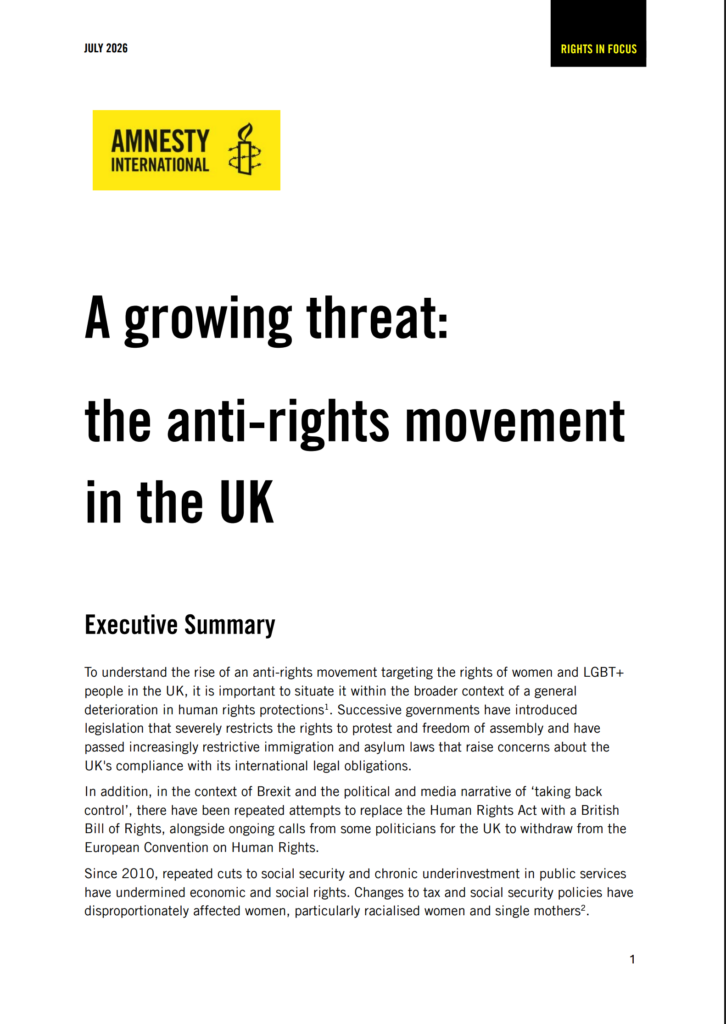
The new report made some observations that everyone who has been following the current anti-trans hysteria will recognize:
TERFs are part of a larger anti-human rights system
The gender critical movement is part of a larger system of anti-rights organizations, that target women, immigrants, LGBTQ-people, people of color and more. Amnesty put it this way:
“These organisations form part of a wider anti-rights ecosystem—a network of groups that work on different issues but share similar goals and often support each other’s efforts to roll back human rights protections.”
J.K. Rowling and the “trans-exclusionary radical feminists” (TERFs) are unsurprisingly uncomfortable with being grouped with fascists and religious extremist, even though they as far as trans people go share the same opinions and use the same talking points.
(Amnesty does not use the tern TERF, and refer instead to “gender critical” organizations.)
The effects on other groups
Another point that is bound to make any TERF angry is Amnesty pointing out that they by targeting fundamental human rights principles, also undermines the protection of cis people.
Yes, the following paragraph is primarily addressing religious fanatics and the extreme right, but the main argument holds true: When you violate fundamental human rights principles when addressing one marginalized group, that will make it more likely that others will use the same tactics against other groups.
“Some of these groups describe themselves as ‘anti-gender’ because they visibly oppose the rights and equality of women and LGBT+ people. However, by targeting women and LGBT+ people, they also challenge a fundamental human rights principle: that human rights belong to everyone equally. Human rights are interconnected and mutually reinforcing. When the rights of one group are restricted, protections for others can also be weakened, even where the effects are not immediately visible.”
The origins of “gender ideology”
In the report Amnesty also argues that nearly anti-rights groups, TERFs included, use the term “gender ideology” to present some undefined and false idea of a conspiracy of fanatics trying to upend the natural order of society and nature.
“Anti-rights actors seek a society in which women and men have fixed and distinct roles, based on what they view as ‘natural’ and ‘traditional’. These actors perceive the idea that gender is socially constructed as a threat because it suggests that gender roles can, and do, change across societies and over time.
“In fact, progress in the rights of women and LGBT+ people has been underpinned by changing understandings of gender and social roles.
Anti-rights actors refer to this perceived threat as ‘gender ideology’, portraying it as an attack on national traditions, family structures, marriage and religious freedom. These narratives often seek to generate fear and uncertainty and rely on misinformation or exaggerated claims.”
Let me add here that all the reactionary groups Amnesty cover make use of the concept of “biological sex” to stop any discussion of what is clearly true: That for some people the gender assigned at birth does not match their deep experienced identity. The anti-trans activists are suppressing this scientifically documented truth by insisting that gender and “biological sex” are the same.
The irony is that the groups that talk about a monolithic gender ideology conspiracy, are themselves part of a such a conspiracy. That is a conspiracy where a large group of organizations and activists present the same simplistic and misleading narratives about both sex and gender in order to defend their irrational hatred of trans people.
The Gender Critical category is the largest
Of all the hate groups identified (my term, not Amnesty’s) the gender critical group is the largest.
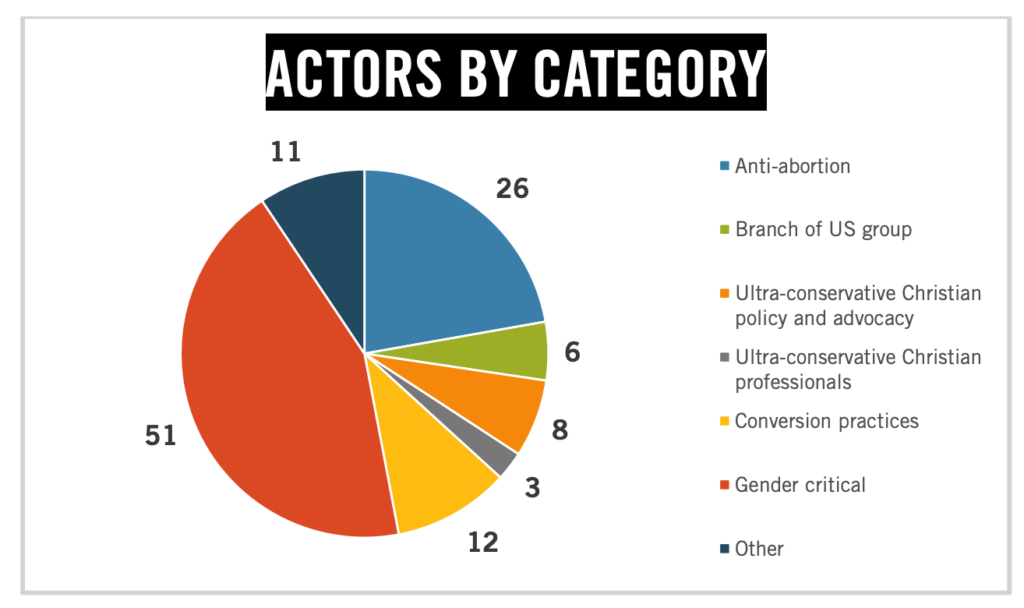
Note that this figure in itself is extremely dangerous for the TERFs. It gives people a clear picture of the fact that gender critical activism is part of a larger system of oppression, hate and persecution.
J.K. Rowling’s reaction to all of this is predictable. She presents herself and her transphobic allies as victim of Amnesty’s oppression. Amnesty, according to her, believes that some people do not deserve rights, as women, girls and those who are same-sex attracted.
This is classical psychological projection: Accuse your opponent for being like yourself. This is, of course, completely unbelievable. Amnesty has an impeccable reputation as regards the rights of women and LGBTQ people. And this very report was written in defense of women and queer people.
Rowling is now going to financially support the organizations listed by Amnesty.
Note that the report was written and published by the UK branch of Amnesty International. The international organization was apparently not involved in the production of the report.
The organizations listed
The report also included a list of the anti-rights organizations mapped by Amnesty. The TERFs need to stop this list from becoming public knowledge, because having a renowned human rights organization add you to a list with conversion therapy supporters, anti-abortionists, fascists and religious fanatics undermines the idea that you are a democratic defender of defenseless women and children.
Amnesty UK did probably make a mistake here, as they did not explain why the various organizations meet the “anti-rights” definition. An appendix with that information would have saved them from a lot of legal problems.
The inclusion of Beira’s Place, Rowling’s cis women-only support service for sexual-violence survivors, makes sense, but it allowed opponents to claim that Amnesty has “blacklisted” a rape-crisis service. They can now use this to redirect the discussion from the oppression of trans people to the oppression of a white, upper class, reactionary hater with a fortune of 1.2 billion US dollars.
I am afraid that fighting evil is a complex play of chess where you have to think at least five moves ahead and understand that your opponent may change the rules at any time.
Here are the gender critical organizations and networks listed in the report.
Seen Network (Sex Equality and Equity Network Limited)
Seen in the City
SEEN in HR
Parli SEEN
SEEN in STEM
SEEN in Journalism
SEEN in Schools
SEEN in Sport
SEEN in Health
SEEN in Retail
Local Authority SEEN
TU SEEN
SEEN in Publishing
Third Sector SEEN
Police SEEN UK
SEEN on Campus
FiLiA
Bayswater support group
Children of Transitioners
Get the L Out UK
Gender Critical Greens
Labour Women’s Declaration
Legal Feminist
Lesbian Strength
Merched Cymru
OBJECT – Women Not Sex Objects!
Older Feminist Network
Protect & Teach
Safe Schools Alliance UK (SSAUK)
Trans Widows Voices
Virago Women’s Workshop
LGB Alliance Cymru
Beira’s Place
Conservatives for Women
Fair Play for Women
For Women Scotland
Gay Men’s Network UK
Keep Prisons Single Sex
Let Women Speak (formerly Standing for Women)
LGB Alliance
The Lesbian Project
Transgender Trend
Woman’s Place UK (WPUK)
Women’s Declaration International (WDI)
Sex Matters
Murray Blackburn and Mackenzie Women’s Rights Network (WRN) LGB Christians
Liberal Voice for Women
ScotPAG Scottish Professionals Advising on Gender
See also:
BBC: Amnesty ‘regret’ over criticism of JK Rowling’s sexual violence support centre
Newsweek: Amnesty International’s Clash With JK Rowling Charity Explained
LGBTQ Nation: JK Rowling encourages anti-trans groups to sue human rights org for labeling them “anti-rights”
Erin Reed: TERF Activist J.K. Rowling Threatens To Finance Wave Of Attacks On Amnesty International Over Report On Anti-Trans Groups